Wet Room Flooring UK 2026: Best Non-Slip Options for a Zero-Threshold Shower
October 17, 2026•admin•15 min read
Wet Room Flooring UK 2026: Best Non-Slip Options for a Zero-Threshold Shower
A wet room is not just a bathroom without a shower tray — it’s a fundamentally different environment that requires fundamentally different flooring. The floor must be fully waterproof (not just water-resistant), correctly sloped to drain, and — critically — slip-rated to a standard that will keep the floor safe when it’s wet underfoot and soapy. Many wet room flooring UK installations fail on this last point: homeowners choose tile they like the look of without checking the slip rating, and end up with a floor that’s beautiful but genuinely dangerous when used as intended. This guide covers what makes wet room flooring different, how slip ratings work, the best flooring options for UK wet rooms in 2026, and the tanking systems that make any of it possible.
This article contains affiliate links. If you buy through them, we may earn a small commission at no extra cost to you. This doesn’t affect our editorial independence — we only recommend products we’d genuinely suggest to a friend.
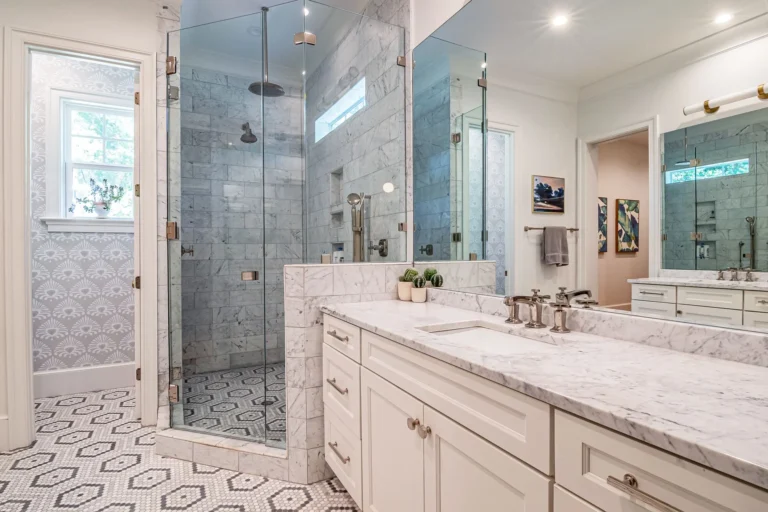
Small-format porcelain mosaic tiles are the benchmark choice for wet room floors — more grout lines mean more grip, and the small tile size accommodates a sloped floor to drain more easily.
What Makes Wet Room Flooring Different from Standard Bathroom Flooring
Standard bathroom flooring is permanently wet in only a small area — inside a shower tray or bath. The main floor area gets occasional splashes and is generally dry underfoot. Wet room flooring is different in three critical ways:
The entire floor surface is a potential shower zone. In a zero-threshold wet room, there is no tray to contain water — it drains across the floor. The entire floor surface will be wet every time the shower is used.
The floor must slope to a drain. Typically 1:80 fall (12.5mm drop per 1m) toward a linear drain or a central point drain. This slope must be built into the structure, which affects both the subfloor preparation and the flooring choice.
The waterproofing must be total. In a standard bathroom, you tile over the subfloor and rely on the tray seal and wall-floor junctions. In a wet room, the entire floor — and wall junctions — must be tanked (waterproofed) before the floor finish is applied. If the tanking is inadequate, water will penetrate the structure, cause rot in timber subfloors, and eventually require complete strip-out and remediation at significant cost.
Slip Ratings Explained: What R9, R10 and R11 Actually Mean
Slip resistance in floor tiles is measured by the DIN 51130 standard (the R-rating system) and the BS 7976 Pendulum test (the PTV system). The R-rating is the most commonly referenced for tile specification in the UK:
R9: Minimum slip resistance. Suitable for dry indoor areas — living rooms, bedrooms, corridors. Not suitable for bathrooms or kitchens where water is regularly present underfoot.
R10: Wet area rating. Suitable for standard bathrooms, kitchens, and areas that are occasionally wet underfoot. This is the minimum for bathroom flooring with a standard shower tray.
R11: Wet, slip-hazard areas. This is the minimum rating for wet room floors, pool surrounds, and areas that are continuously wet when in use. The additional texture required to achieve R11 is significant — you will feel it underfoot as a more aggressive surface grip.
R12+: Industrial wet areas, ramps, commercial kitchens. Usually overkill for domestic wet rooms but sometimes specified by architects for high-use facilities.
The UK Building Regulations Approved Document M (Access to and use of buildings) requires that floor surfaces in wet rooms be slip-resistant and, in accessible bathrooms for disabled persons, specifies a minimum Pendulum Test Value (PTV) of 36 in wet conditions. Any flooring you specify for a wet room should have a slip resistance test certificate from the manufacturer — ask for it if it’s not included in the product datasheet.
Best Wet Room Flooring Options UK: What Works and What Doesn’t
1. Porcelain Mosaic Tiles — Best Overall Wet Room Flooring
Small-format porcelain mosaic tiles (typically 25×25mm to 75×75mm, supplied on mesh backing sheets for easier installation) are the benchmark choice for wet room floors across the UK professional trade. The reason: more tiles means more grout joints, and grout joints provide texture and grip. A floor covered in 25mm mosaics has dramatically more grout joint length per square metre than a floor covered in 600mm tiles — and proportionally better slip resistance from the grout texture alone, in addition to the tile surface rating.
For wet rooms, specify porcelain mosaic tiles with a minimum R11 rating. Leading UK tile suppliers including Topps Tiles, Fired Earth and tile specialist retailers all carry suitable ranges. Prices: £25–£60/m² for supply, depending on format and brand. Professional installation including adhesive and grout: £40–£70/m² in the UK.
The practical consideration with mosaics: the large number of grout joints requires more maintenance — grout in a wet room needs sealing annually and occasional re-grouting over a 10–15 year period. Use a good quality epoxy grout in wet rooms rather than standard cementitious grout, as it’s more water-resistant and significantly harder to stain.
Best for: Any wet room floor. The professional standard. R11+ / approx. £25–£60/m² supply.
2. Large-Format Anti-Slip Porcelain — Modern Look with Good Slip Rating
For homeowners who prefer the clean, minimal aesthetic of large-format tiles (300×600mm, 600×600mm or larger), there is a growing range of specifically anti-slip porcelain tiles designed for wet room use. These achieve R11 or higher through surface texture — a structured or textured surface finish rather than the inherent grip of a mosaic grout pattern. Brands like RAK Ceramics, Roca and Porcelanosa produce large-format anti-slip wet room tiles that are available through UK tile retailers at £30–£80/m².
The critical check: large-format tiles on a sloped wet room floor require careful setting out to maintain a continuous fall to the drain while keeping tile edges level with adjacent tiles. This is skilled tiling work — a large-format tile floor that looks wavy or has lippage between tiles is the result of inadequate setting out, and it’s extremely difficult to correct without re-tiling. For DIY or lower-budget projects, small-format mosaic is more forgiving of the sloped substrate.
Best for: Contemporary wet rooms where design is a priority and professional installation is planned. R11+ anti-slip / approx. £30–£80/m² supply.
3. Vinyl Sheet — Best Budget Option
For wet rooms on a tight budget, anti-slip commercial vinyl sheet is a viable alternative to tile. Key requirement: sheet vinyl only, not click LVT or peel-and-stick tiles. The joins between click LVT planks or vinyl tiles will allow water ingress over time — in a wet room where water is on the floor constantly, this means the tanking layer underneath will eventually be undermined at every join. A single-piece sheet of commercial anti-slip vinyl eliminates this problem.
Suitable products: Polyflor Polysafe Hydro+ and Altro Aquarius are both commercial anti-slip vinyl sheet products rated R11, designed specifically for wet room and shower room applications. They’re available through commercial flooring suppliers and some specialist bathroom retailers. Supply: £15–£30/m². They need to be heat-welded at any joins and properly coved at the wall junctions — again, this is a job for a professional.
Aesthetically, commercial anti-slip vinyl is less premium-looking than tile — the anti-slip texture is very visible and the range of patterns is limited. For a primary bathroom, most homeowners will prefer tile. For a secondary wet room, utility wet room or disability adaptation project where budget is the constraint, it’s a practical and very durable choice.
4. Resin and Polished Concrete — Bespoke, Requires Professional
Resin flooring (epoxy or polyurethane) and polished concrete are increasingly fashionable in high-end UK wet room and bathroom installations, offering a seamless, completely joint-free surface. Both materials can be installed with anti-slip aggregates incorporated into the finish coat to achieve the required R11 rating. The result is a genuinely stunning, modern finish.
The limitations are significant: both require specialist installation by contractors with specific experience in wet environment resin or concrete work. Costs are high — expect £80–£200/m² installed for quality resin in a wet room. Resin over timber subfloors is problematic (movement can cause cracking) and typically requires a specialist assessment. The finished surface, while non-porous, must still incorporate a compliant tanking system below — resin is the finish, not the waterproofing.
Best for: High-budget bespoke projects with experienced specialist contractors. Not suitable for DIY or standard renovation budgets.
Proper tanking is the foundation of any wet room — the waterproof membrane must be installed across the entire floor and up the walls before any floor finish is applied.
What NOT to Use in a Wet Room
The following should never be used as wet room flooring — regardless of manufacturer marketing claims about water resistance:
Smooth, polished large-format tiles (R9 or unrated): These are extremely slippery when wet. This includes some highly popular ranges from mainstream tile suppliers. Always check the R rating on the tile datasheet — a beautiful tile with an R9 rating is a liability in a wet room.
Laminate flooring: Even moisture-resistant kitchen laminate is not suitable for wet rooms. The HDF core will swell irreversibly and the surface coating will delaminate within weeks of wet room use.
Engineered wood or solid wood: Wood and sustained water contact don’t mix. No wood-based floor is appropriate for a wet room shower zone.
Standard click LVT without full sealing: Click LVT is waterproof at the plank surface, but the click joints are not sealed. In a wet room, water will penetrate the joints and eventually undermine the adhesive or subfloor below. Standard floating click LVT is not appropriate for wet room shower zones.
Standard wall tiles on the floor: Wall tiles are typically R9 rated (suitable for dry use). Many are also rectified thin tiles not rated for floor load bearing. Check the tile datasheet — “suitable for floors” and an R11 rating are both required for wet room use.
Tanking Systems for UK Wet Rooms
Tanking is the process of applying a waterproof membrane to the floor and walls of a wet room before tiling or finishing. It is not optional — it’s the only thing standing between your shower water and the structural timber or concrete below. The three most widely used tanking systems in the UK are:
Schlüter Kerdi
Schlüter’s Kerdi system uses a thin polyethylene membrane with fleece bonding webbing on both sides, which bonds directly to the substrate with tile adhesive. It’s the most widely specified system among UK professional tilers — highly reliable, available from most UK tile merchants and builders merchants, and compatible with all tile types. The Kerdi membrane is used on both floor and walls, with Kerdi-Band fabric tape at all wall-floor and wall-wall junctions. Cost: Kerdi membrane at around £15–£25/m² supply. Widely available through Schlüter’s UK distribution network.
BAL Waterproofing Kit
BAL (British company, owned by Ardex) produces a wet room tanking kit that uses a brush-applied liquid membrane. It’s more DIY-friendly than Schlüter Kerdi — the application is essentially painting the membrane onto the substrate with a roller or brush, then embedding fibreglass reinforcement fabric at joints and junctions. Supply cost for a full wet room kit: approximately £80–£150 for a typical UK shower room. Available from BAL-stocked builders merchants and tile retailers.
Wetroom Store Kits
Wetroom Store (a UK specialist) and similar online retailers sell complete wet room kits that include a pre-formed sloped former (so you don’t have to build the slope in screeding), a linear drain, the waterproof membrane, and the drain connection. These are particularly useful in renovation projects where creating the correct slope in the existing floor structure is challenging. Kits typically start from £200–£400 depending on size, and include fitting instructions designed for both professional and competent DIY installation.
Prices correct at time of publication. For the broader context of bathroom flooring choices beyond wet rooms — including standard shower room tile, LVT and vinyl options — see our bathroom flooring UK guide. For installation and fitting cost guidance covering a range of flooring types, our flooring installation cost UK guide provides current UK benchmarks. For homes combining a wet room with underfloor heating, our underfloor heating compatible flooring guide covers the essential compatibility checks before tiling.